



The year 2025 marked a pivotal moment for India in terms of UNESCO recognitions, featuring numerous new entries across various UNESCO programmes. These additions encompass World Heritage Sites, entries on the Tentative List, Intangible Cultural Heritage, the Memory of the World Register, the Creative Cities Network, and Global Geoparks. Recently, seven extraordinary natural heritage sites in India have been successfully added to UNESCO’s Tentative List of World Heritage Sites. As a result, India now has a total of 69 sites under consideration by UNESCO, which includes 49 cultural, 17 natural, and 3 mixed heritage properties. This accomplishment enhances India’s position as a global leader in the preservation of living traditions and natural marvels. The newly included sites consist of
The Deccan Traps at Panchgani & Mahabaleshwar, Maharashtra
The Deccan Traps located at Mahabaleshwar and Panchgani represent one of the most extensive volcanic formations on the planet, taking the shape of a substantial shield volcano. The formation of the Deccan Traps commenced approximately 66.25 million years ago, coinciding with the conclusion of the Cretaceous period; however, it is conceivable that some of the oldest materials may lie beneath more recent deposits. These Traps illustrate the intricate relationship between geological importance and the conservation of biodiversity. The Mahabaleshwar Deccan Traps also hold global stratigraphic importance due to the preservation of lava flows exceeding 2,000 meters in thickness, which can be observed in the striking geographical features along the Mahabaleshwar hills, among the must-include places in Maharashtra tour packages. Additionally, the Deccan Traps are included within the designated Koyna Wildlife Sanctuary, part of the Western Ghats Biosphere Reserve, which is recognized as a UNESCO World Heritage Site.
Book Here: Mahabaleshwar Tour Packages
Geological Heritage of St. Mary’s Island Cluster, Karnataka
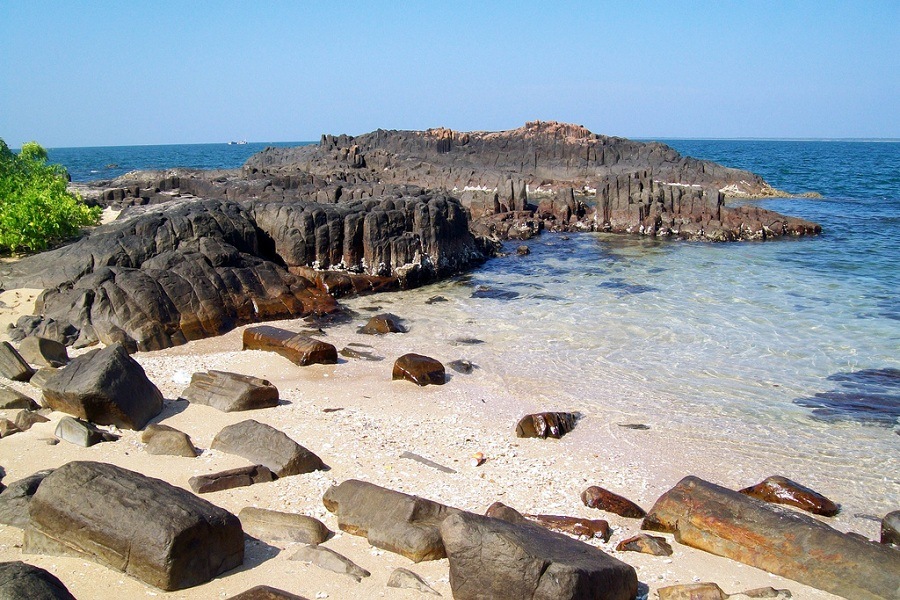
St. Mary’s Islands comprise a collection of four small, scenic islands located off the western coast of India, near Malpe, a quaint coastal village approximately six kilometers west of Udupi, which is one of the most revered pilgrimage sites in Karnataka. The four islands include Coconut Island, North Island, Darya Bahadurgarh Island, and South Island. Renowned for their rare columnar basaltic rock formations, this group of islands dates back to the Late Cretaceous period, offering valuable insights into the continental drift of the Indian subcontinent and serving as a distinctive example of volcanic history. These basaltic formations are thought to have been created by the gradual cooling and contraction of lava during the separation of the Indian and Madagascar tectonic plates around 85 million years ago. The rhyolites of St. Mary’s exhibit a remarkable development of granophyric texture, recognized as one of the most striking and aesthetically pleasing igneous rock textures present in India. This cluster of islands has been included on India’s Tentative List for UNESCO World Heritage Sites, highlighting its potential as a candidate for international heritage recognition.
Book Here: Udupi Tour Packages
Varkala Cliffs, Kerala
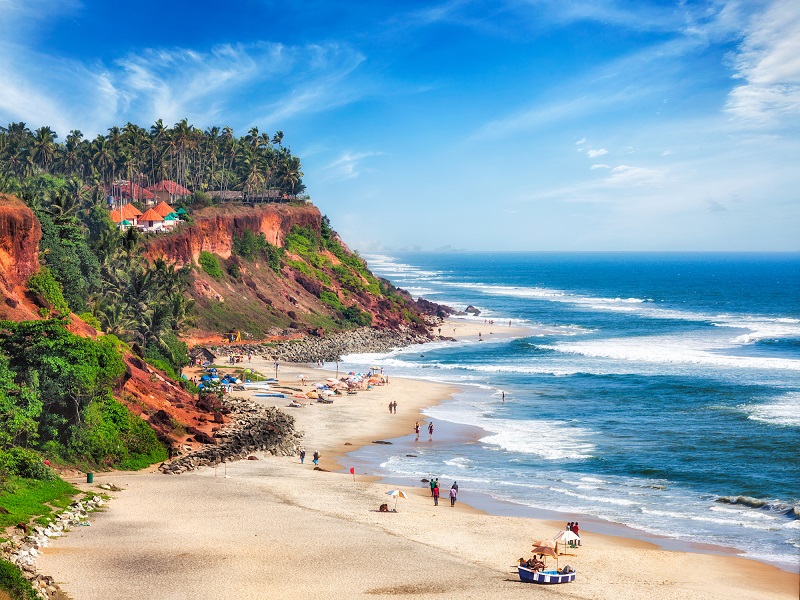
Varkala Cliff is a striking red laterite formation located next to the Arabian Sea in Varkala. Rising to a height of 80 feet, this cliff is remarkable as it serves as a detailed record of geological transformations from the Mio-Pliocene epoch, which spans from 1.3 to 25 million years ago. Its sedimentary geo-morphological composition provides evidence of distinctive geological characteristics, including alterations in sea and soil structures, and even contains small fossils embedded within. The cliffs are referred to as the ‘Warkallai formation’ by the Geological Survey of India and have been recognized as a potential Geopark by UNESCO. While there are 90 geoparks globally, Varkala Cliff holds the distinction of being the first in India. Efforts are underway to designate it as a National Geological Monument by the Geological Survey of India, and proposals have been made for its preservation, including the construction of a seawall along the cliff’s length. In addition to its significance as a geo-heritage site, Varkala Cliff & Beach is also a favored recreational spot, attracting over two lakh international and domestic tourists annually as part of Varkala tour packages. The low-lying, shimmering beach of Varkala seems to extend endlessly on both sides, offering breathtaking views.
Book Here: Kerala Tour Packages
Meghalayan Age Caves, Meghalaya
Meghalaya is recognized as one of the regions globally with the highest recorded levels of rainfall. These unique climatic conditions, along with intense solutional weathering, have contributed to the development of numerous caves within the silicate-rich lithologies of Meghalaya. Notably, four caves—Mawmluh, Arwah, Mawsmai, and Krem Puri—have been nominated as part of India’s seven new entries to the tentative list of the UNESCO World Heritage Convention under the natural category. The Meghalayan Age Caves represent some of the few locations worldwide where ongoing geological processes are clearly observable, allowing for the continuous formation of stalactites and stalagmites. This provides scientists with the opportunity to examine geological processes and time series in an environment that remains largely undisturbed. The Meghalayan Age Caves rank among the longest of their type globally. Many of these caves feature stunning decorative rock formations, including chandeliers, stalactites, stalagmites, as well as pools of water and underground rivers, collectively creating an extraordinary and rare cave landscape. Krem Puri cave extends 24.5 km in length and spans an area of 13 sq. km in the verdant region of Mawsynram. The cave presents an incredibly intricate maze comprising hundreds of short passages and lengthy corridors that are interconnected within a vast network.
Book Here: North-East India Tour Packages
Natural Heritage of Tirumala Hills, Andhra Pradesh
Situated at an elevation of 980 meters, the Tirumala Hills, a series of seven peaks within the Seshachalam range of the Eastern Ghats, are home to the renowned Sri Venkateswara Swamy Temple, one of the most sacred pilgrimage sites in India. The Tirumala Hills in Andhra Pradesh hold considerable importance due to their geological, ecological, and cultural significance. This region showcases the Eparchaean Unconformity, a geological boundary where rocks over 2.5 billion years old intersect with younger Proterozoic formations of the Cuddapah Supergroup, highlighting a crucial gap in the Earth’s history. Additionally, the area features the Natural Arch, or Silathoranam, a unique rock formation located near the Tirumala temple, believed to be over 1.5 billion years old. The hills are part of the Seshachalam Biosphere Reserve and Venkateswara National Park, which host a variety of flora and fauna, including the endangered red sanders, Cycas beddomei, and Jerdon’s Courser. With its seasonal waterfalls, dense forests, and abundant biodiversity, this site meets several UNESCO criteria for Outstanding Universal Value, encompassing natural beauty, geological significance, and ecological importance.
Book Here: Tirupati Tour Packages
Naga Hill Ophiolite, Nagaland
The Naga Hills are a segment of a complex mountain system, located within the Indian state of Nagaland and the Burmese region of Sagaing. These hills are renowned for their geological feature known as ‘ophiolite,’ which consists of fragments of oceanic plates that have been thrust onto the edges of continental plates. The Naga Hill Ophiolite is composed of a diverse array of Mesozoic and Cenozoic magmatic and sedimentary rocks that originated at the India-Myanmar convergent plate boundary, bordered tectonically to the east by the metamorphic units of the Naga Metamorphic Complex. Furthermore, the Naga Hills host four confirmed Key Biodiversity Areas and Important Bird Areas, including the Satoi Range, Mount Ziphu, Fakim Wildlife Sanctuary & Saramati Area, and Pfutsero-Chizami. Additionally, it is recognized as part of the Endemic Bird Area (EBA) within the Eastern Himalayan Region. The Nagahill Ophiolite Site (NHO), located near Pungro in the Kiphire district of Nagaland, has been designated a National Geological Monument of India by the Geological Survey of India (GSI) to ensure its protection, maintenance, promotion, and enhancement of geotourism. This site has also been included in India’s seven new submissions to the tentative list of the UNESCO World Heritage Convention under the natural category.
Book Here: India Heritage Packages
Erra Matti Dibbalu, Andhra Pradesh
Erra Matti Dibbalu, also known as the Red Sand Hills, is a designated National Geo-heritage Monument situated close to the Bay of Bengal along the coastal region of Visakhapatnam. This location is an essential inclusion in Vizag tour packages due to its distinctive and rare red sand formations. The area spans approximately 1500 acres and showcases natural dendritic-patterned drainages across its vivid red sediment mounds. These red mounds, made up of sand, silt, and clay, derive their remarkable uniform reddish color from natural oxidation over thousands of years. Erra Matti Dibbalu preserves evidence of ancient geological processes, such as fluctuations in sea level, climate change, erosion, and sediment deposition. This region serves as a living testament to the dynamic history of our planet. The fascinating formations were first recorded by William King, the deputy superintendent of the Geological Survey of India, in 1886, at which time they were referred to as ‘badlands.’ Only two other comparable sites are found globally, one in Sri Lanka and another in Chennai, Tamil Nadu.
Book Here: Andhra Tour Packages
*Featured Source
